Swarey Portable Power Station Buying Guide

Most people meet watts, amps, and volts the same way I did: a breaker that keeps tripping, a new appliance that needs a dedicated circuit, or a generator that dies the moment the fridge kicks on. You don't need an engineering degree to sort out any of these. You need one formula, a handful of reference numbers, and maybe ten minutes with the labels on your appliances. The formula does most of the work. In simple terms, watts measure power, amps measure current, and volts measure the pressure pushing that current through the wire. They connect through the power equation: watts = volts x amps. The U.S. Energy Information Administration counts household electricity in units of power called watts in its electricity explainer — that unit, named for James Watt, is the denominator behind every bill and every breaker rating. Everything else in this guide grows from that single fact.
How to Calculate Watts (the starting point for everything below)
Amps x Volts = Watts
If you already know the voltage and the current, you have everything needed to calculate watts. Multiply the two. A device that draws 5 amps from a standard 120-volt US outlet uses 5 x 120, which comes to 600 watts. A charging phone is closer to 5 watts; a space heater is often 1,500 watts. Same arithmetic, wildly different scale. That "amps x volts = watts" relationship is worth memorizing as-is. The Electrical Safety First units calculator explains it the same way: amps multiplied by volts equals watts. Once you accept that, the other two conversions are just the same equation rearranged.
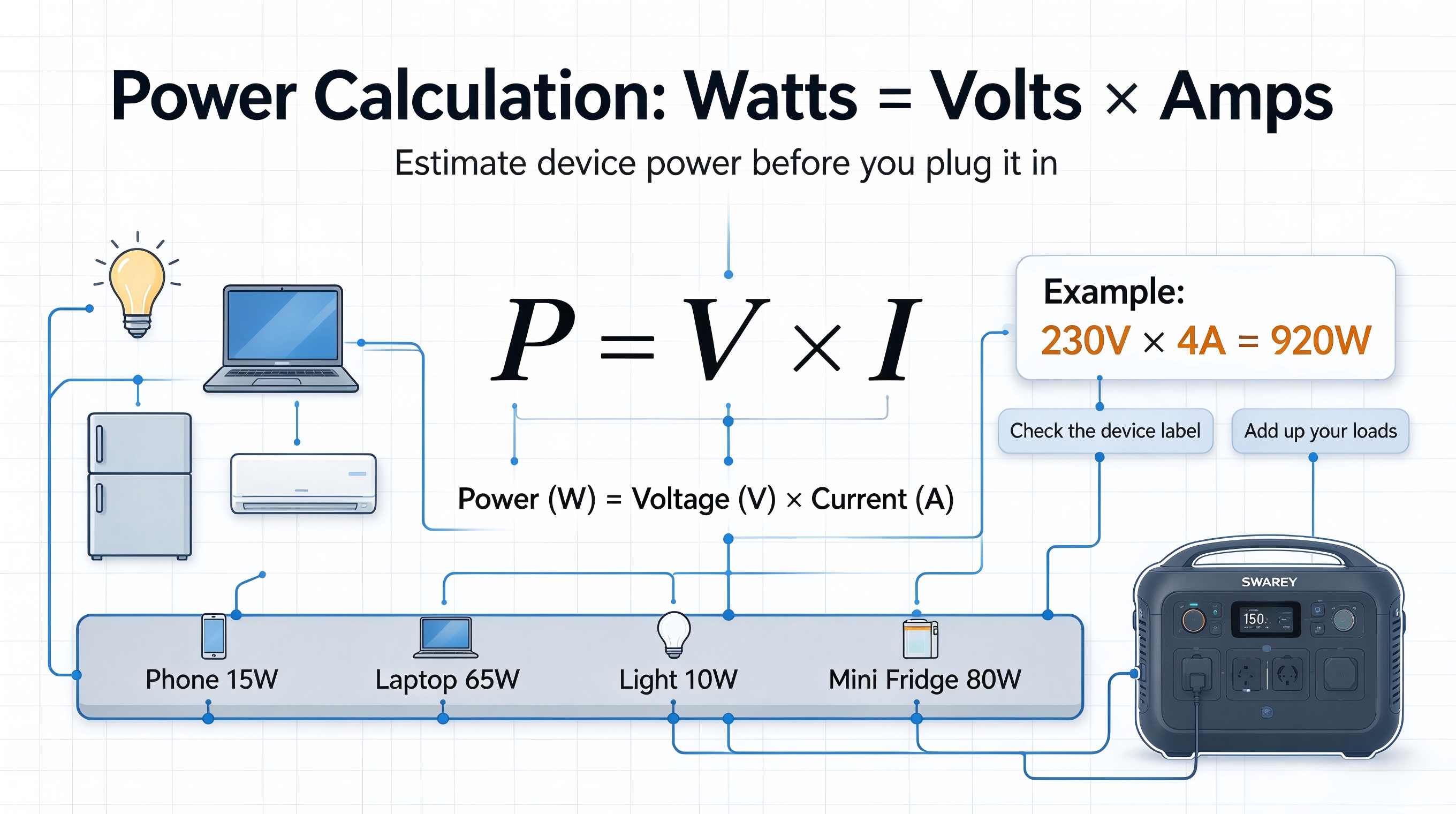
How Do You Calculate Watts?
Grab the two numbers from the appliance label: the rated voltage and the rated current, printed as V and A. Multiply them. Example: a toaster oven rated 120V / 12.5A → 120 x 12.5 = 1,500 watts. If the label only lists watts, you have your answer already. If it lists neither watts nor amps, search the model number online or measure the actual draw with a plug-in watt meter.
How Do I Figure Wattage?
For a single appliance, "figure out the wattage" is the same operation: read the label, multiply volts by amps. For a whole room or a whole house it means adding up every device that could run at the same time. That total is the number that decides whether your wires, your breaker, and any backup power source are big enough. So whether you want to know how to calculate wattage in general, how to figure watts for one appliance, or how to find watts for everything in the kitchen, the recipe never changes: label numbers in, multiplication out. And the tool that settles every argument is cheap. A plug-in watt meter — the kind that sits between the wall outlet and your appliance — shows live watts, amps, and volts on a small screen. Plug the fridge in through one for a week and you'll know its real running draw and its startup spike without guessing. That measurement also settles the label-versus-reality question: nameplates print the maximum the device is allowed to draw, not necessarily what it draws most of the time. Not ready to buy a meter? The nameplate itself usually gets you close enough. Voltage is printed on every US appliance (120V or 240V, occasionally marked 115/230), and amps are either printed directly or buried in the model spec online. If the appliance only gives you watts, the amps are one division away. That last version is how to figure amps without touching a single wire: take the wattage, divide by your line voltage, done. And if the label only lists resistance — rare in household gear, common in heater elements and some imported appliances — Ohm's law closes the loop: amps = volts ÷ ohms, then multiply by volts again for watts. That's how to determine watts for anything, no matter what the sticker gives you.
Amps vs. Volts: How to Calculate Amps From Watts
Turning it around: amps = watts ÷ volts. If an appliance uses 1,200 watts on a 120-volt circuit, it draws 1,200 ÷ 120 = 10 amps. This is the calculation that matters before you plug anything into a circuit that already has other stuff running on it. A word about the 80% rule while we are here. Breakers are not meant to run at 100% of their rating continuously. Standard practice, and the convention most electricians apply, keeps continuous loads at 80% of the breaker size — a 15-amp circuit comfortably carries 12 amps of sustained load, a 20-amp circuit carries 16. That cushion is exactly why a 1,500-watt heater (12.5 amps) feels fine on a 15-amp circuit until a second heater joins it.
How Many Watts Are in an Amp?
There is no fixed answer, because an amp only becomes watts when you know the voltage. At 120 volts, 1 amp = 120 watts. At 240 volts, 1 amp = 240 watts. On a 12-volt DC circuit, one amp is just 12 watts. This is why "how many watts are in an amp" always needs the voltage attached to it, and why the same appliance can pull half the amps on a 240-volt circuit that it pulls on 120 volts.
How to Find Amps on an Appliance Label
Manufacturers print the amp rating right on the nameplate, usually near the model number. You'll see something like "120 V, 12.5 A" or "Input: 5.0 A". When in doubt, grab the label's wattage and divide by your home's voltage — that gives you the amps it will actually draw. If the sticker is worn off, the FTC's EnergyGuide label explainer reminds us that the yellow tag on refrigerators and other large appliances tells you how much energy the appliance uses, which is your next best clue.
How Many Amps Is 1500 Watts?
The short answer: 12.5 amps at 120 volts, or 6.25 amps at 240 volts. Divide 1,500 by the voltage you are working with. This exact number comes up constantly because 1,500 watts is the default rating for space heaters, hair dryers, many microwaves, and toaster ovens — the appliances that trip breakers most often.
|
Load |
At 120V |
At 240V |
|
1,500 W |
12.5 A |
6.25 A |
|
1,000 W |
8.33 A |
4.17 A |
|
15 A circuit max (80% rule) |
1,440 W |
2,880 W |
|
20 A circuit max (80% rule) |
1,920 W |
3,840 W |
Notice where 1,500 watts lands: it's under the 80% ceiling of a 15-amp circuit, but only just. That's why running a space heater at the same time as a microwave on the same circuit so often ends with a dark kitchen.
Refrigerator and Microwave Amps: the Two Appliances That Matter
Cold food and hot food are the two loads everyone worries about, whether they are working out a new circuit or sizing a backup power station. Both numbers vary by model, so treat these as planning ranges and confirm against your own labels.
How Many Amps Does a Refrigerator Use?
A typical full-size residential refrigerator draws roughly 3 to 8 amps while the compressor runs, with most modern models sitting in the 3-to-6-amp range. The catch is the startup moment: the compressor can briefly pull two to three times its running current for a second or two. That surge is why a fridge on a generator or a battery station needs headroom, not just a wattage total that looks comfortable on paper.
How Many Amps Does a Fridge Use?
Same question, slightly different wording — and the answer is the same, with one clarification. When people ask how many amps a fridge uses, they usually mean the running amps during normal operation, which for a compact or mini fridge can be as low as 1 to 2 amps. A refrigerator with a freezer on top runs closer to 3 to 5 amps, and a larger French-door unit can sit at 6 to 8. The precise figure is printed on the label inside the fresh-food compartment.
How Many Amps Does a Microwave Use?
A household microwave rated at 1,000 cooking watts typically draws around 8 to 10 amps from a 120-volt circuit, because the input power is higher than the output power — the magnetron and electronics waste some energy as heat. Bigger units rated 1,200 watts or more can pull 12 to 15 amps, which is why kitchen codes often give microwaves a dedicated 20-amp branch circuit. If yours shares a line with a toaster or a kettle, the math for simultaneous use gets tight fast.
How Many Watts Is 1 Horsepower?
Horsepower shows up on motors — well pumps, garage compressors, furnace blowers, and the occasional stubborn table saw. One mechanical horsepower equals about 745.7 watts, as Wikipedia's horsepower article defines it, and the electric horsepower used on motor nameplates is an even 746 watts. Translation for the rest of us: each horsepower of motor load needs roughly 750 watts, plus a generous startup surge that can hit double the running figure for a split second. A 1 HP well pump, then, is a 750-watt load that you shouldn't size a circuit or a generator for without counting the inrush. If you ever asked how many watts 1 hp is because a pump spec sheet only gave you horsepower, the short answer is the 750-watt figure — and the long answer is to read the motor nameplate for its actual full-load amps, because that number is what your wires actually carry.
How to Calculate Voltage Drop on Long Wire Runs
Voltage drop is the silent cousin of the electrical family. Every wire has resistance, and that resistance eats a little of your voltage the longer the run gets. The calculator.net voltage drop calculator starts from the same place every electrician does: Ohm's law, where voltage drop equals current times resistance. For a single-phase circuit with two conductors, that becomes roughly 2 × current × resistance-per-1000ft × length, which is why long extension cords and undersized wires starve appliances of power even when the breaker never trips. How much drop is too much? The widely used guidance, echoed by electriciancalc's NEC-based calculator, recommends no more than 3% voltage drop on a branch circuit and 5% total for the feeder plus branch combined. Exceed that and motors run hot, lights dim, and tools lose power. The fix is usually simple: bigger wire, shorter run, or both.
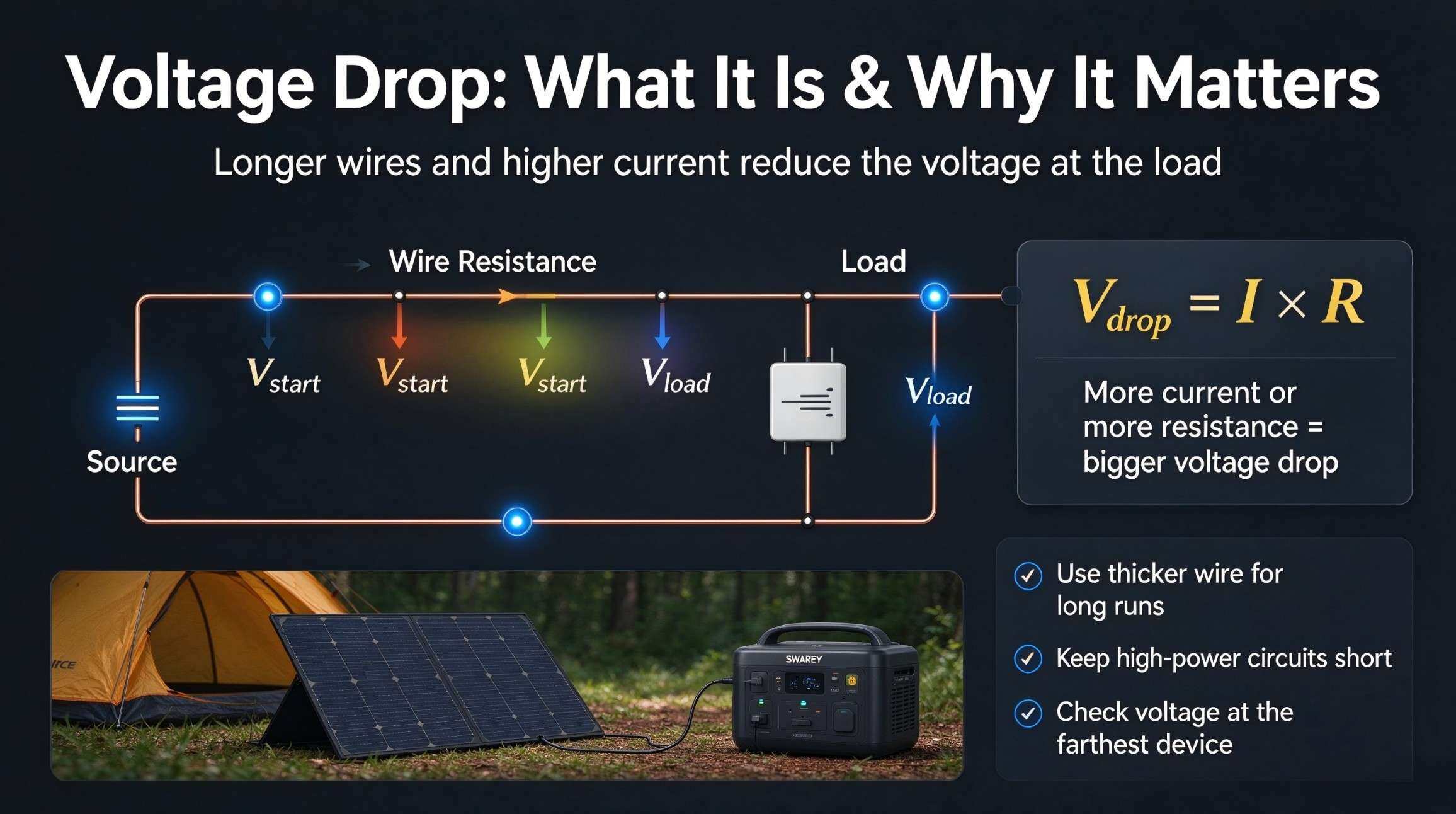
The Voltage Drop Formula in Plain Terms
Worked example: a 15-amp load on a 120-volt circuit, 100 feet from the panel, on 12 AWG copper. The round-trip resistance of that wire is roughly 0.32 ohms. Voltage drop = 15 A × 0.32 Ω ≈ 4.8 volts, which is exactly 4% of 120 — over the 3% branch recommendation. Bumping to 10 AWG roughly halves the resistance and brings the drop comfortably under 3%. If that last paragraph made your eyes glaze over, the takeaway is the one you'll actually use: for anything beyond a modest run, use the next wire gauge up and you'll be fine.
Putting the Math to Work: How Many Watts Does Your Home Really Use?
Here's where the reference material turns into a plan. Walk the house with this list and fill in the nameplate numbers — that ten-minute exercise answers most sizing questions for good:
- Fridge and microwave — note the amps, add 50% headroom for compressor and magnetron startup.
- Anything that heats — space heaters, kettles, hair dryers, toasters. 1,500 watts each is the usual floor.
- Motors — furnace, well pump, garage door. Each horsepower ≈ 750 watts running, more at startup.
- Add it up for the circuits that matter — your kitchen line, your bedroom heater circuit, and any single outlet that powers multiple devices.
- Compare against the 80% rule — 15-amp breaker = 1,440 watts continuous; 20-amp = 1,920 watts.
That final number is also your backup-power number. A fridge at ~600 watts running plus a microwave at ~900 watts plus lights and a phone charger lands most households in the 1,200-to-2,000-watt band — which is exactly the range where small solar generators start to make sense. A unit that matches your running load with headroom for startup surges, like the battery stations SWAREY builds for this use case, keeps the essentials alive without asking you to run the whole house off a portable outlet.
FAQ: Quick Answers to the Same Questions Everyone Asks
How do I calculate watts from amps and volts? Multiply: watts = amps x volts. 10 amps at 120 volts = 1,200 watts. Is 1,500 watts safe on a 15-amp circuit? It's 12.5 amps, under the 15-amp rating but above the 12-amp (80%) continuous-load guideline — fine in short bursts, marginal for hours. Do refrigerators really surge? Yes. Running at 3-8 amps, but 2-3x that for the first second or two when the compressor starts. What size generator do I need for a fridge and microwave? Add their running wattages (~600 + ~900 = ~1,500), then add 30-50% for startup and lights. The buying guides on this site walk through the full method. Where do I find an appliance's wattage? The nameplate, the EnergyGuide label, or the owner's manual. Failing all three, a $15 plug-in watt meter gives you the real number in one cycle.
The Bottom-Line Difference Between Guesswork and Knowing
Every breaker trip, every undersized extension cord, every generator that stalls at the worst moment traces back to the same missed step: nobody multiplied volts by amps. The entire subject of home electricity math compresses into three lines — watts = volts x amps, divide by volts to get amps, and keep long wire runs under a 3% drop. Write those on a sticky note, fill in the two appliance numbers that matter most (fridge and microwave), and the rest of this guide becomes background reading instead of a puzzle. And when the power goes out, that same fifty cents worth of arithmetic decides whether your backup setup breathes or dies: match the running watts, respect the surge, and keep the circuits you feed under their 80% ceiling. That's the whole game — and it's why SWAREY's S1000 solar generator (725Wh, 1000W continuous / 1500W peak) and the S500 (518Wh) exist: they're sized in exactly the wattage language this guide teaches. If the numbers say you need about 1,500 watts with headroom for the fridge surge, that is a fixable problem — not a crisis.
Subscribe To Our Newsletter
You Can Get The News Of Our Products
SIGN UP
Making every connection simpler, and every charge more valuable.
Payment Methods