Portable Power Station Size Guide: How to Choose the Right Capacity

The first time the power goes out in a storm, most people learn the hard way that a generator is not an appliance you plug in and forget. It is a small power plant you have to understand before you need it: how it makes electricity, how big it needs to be, and how it gets connected to your home without turning the grid into a hazard. Whether your search started with "generator how does it work" or "how many watt generator to run a house," the same four questions come up: how does a portable power station work, what size do I need, how do I use it, and how do I hook it up? This guide answers all four, in plain language.
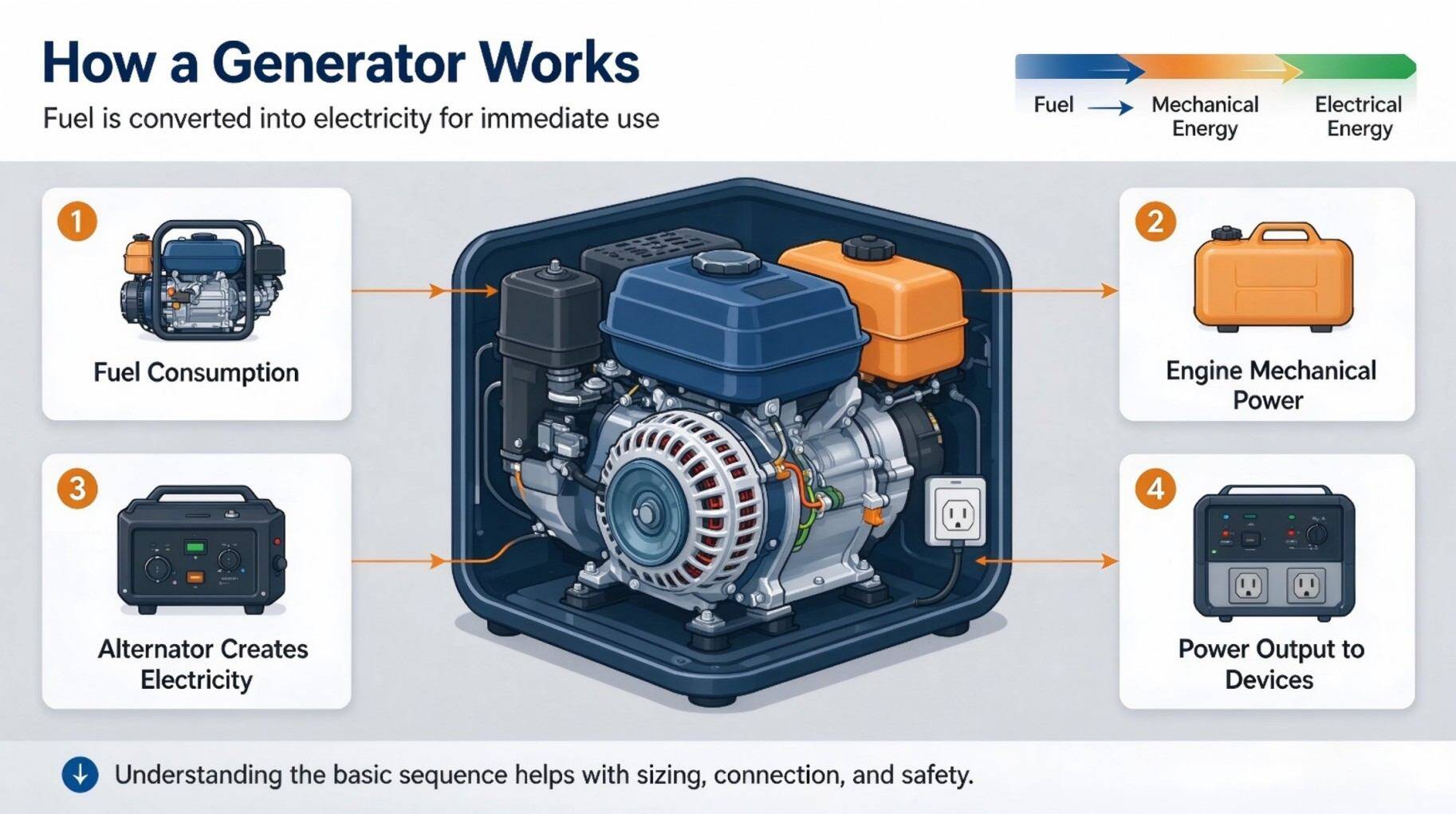
How a Portable Power Station Works
A portable power station is a different kind of generator. Instead of converting mechanical energy into electricity the traditional way, it stores electrical energy in a lithium battery for later use. The core components are:
- Lithium battery (the energy storage)
- Inverter (converts DC battery power to AC household power)
- Charge controller (manages charging from solar panels, wall outlet, or car charger)
- Multiple output ports (AC outlets, USB ports, DC ports, 12V car port)
The process is straightforward: you charge the battery from any available source (solar panels, wall outlet, car charger), and the inverter converts the stored DC power into clean AC power for your appliances. Modern units use pure sine wave inverters that produce electricity as clean as or cleaner than grid power, making them safe for sensitive electronics like laptops, medical devices, and audio equipment. Portable power stations operate silently, produce zero emissions, and are safe to use indoors. Every step of the process, from charging to discharge, is quiet, clean, and odor-free. You simply press a button to turn it on, and it delivers power through its outlets.
How to Use a Generator: Press, Plug, Go
Learning how to use a generator of the battery kind takes about ninety seconds. There is no startup prep beyond pressing the button. The routine is:
- Press the power button on the station.
- Plug your device into the outlet or port on the front: AC outlet for most appliances, USB-C or USB-A for phones, tablets, and laptops.
- Check the display shows the remaining charge and the current draw.
- Press the button again when you are done.
That is the entire operating sequence. The same button starts charging your phone and starts powering a router or a small fridge; the station balances the connected loads automatically. Operation stays quiet and clean from start to finish, which is why these stations are safe indoors, in apartments, in offices, and next to the bed with a CPAP machine. The one habit worth building is matching the device to the right port. Phones and tablets charge fastest from the USB-C port with fast charging. Anything with a wall plug uses the AC outlet. Small DC devices can use the carport or DC output if the station has one. Keeping a short label or memory of which port does what saves you a second of fumbling in the dark, and in an outage that second matters more than it should.
How Big of a Generator Do I Need?
"How big of a generator do I need" is really two questions, because every motor-driven appliance has two numbers. Running watts are what a device draws at steady state. Starting watts, also called surge watts, are the burst a motor needs for the first second or two, often two to three times the running figure.
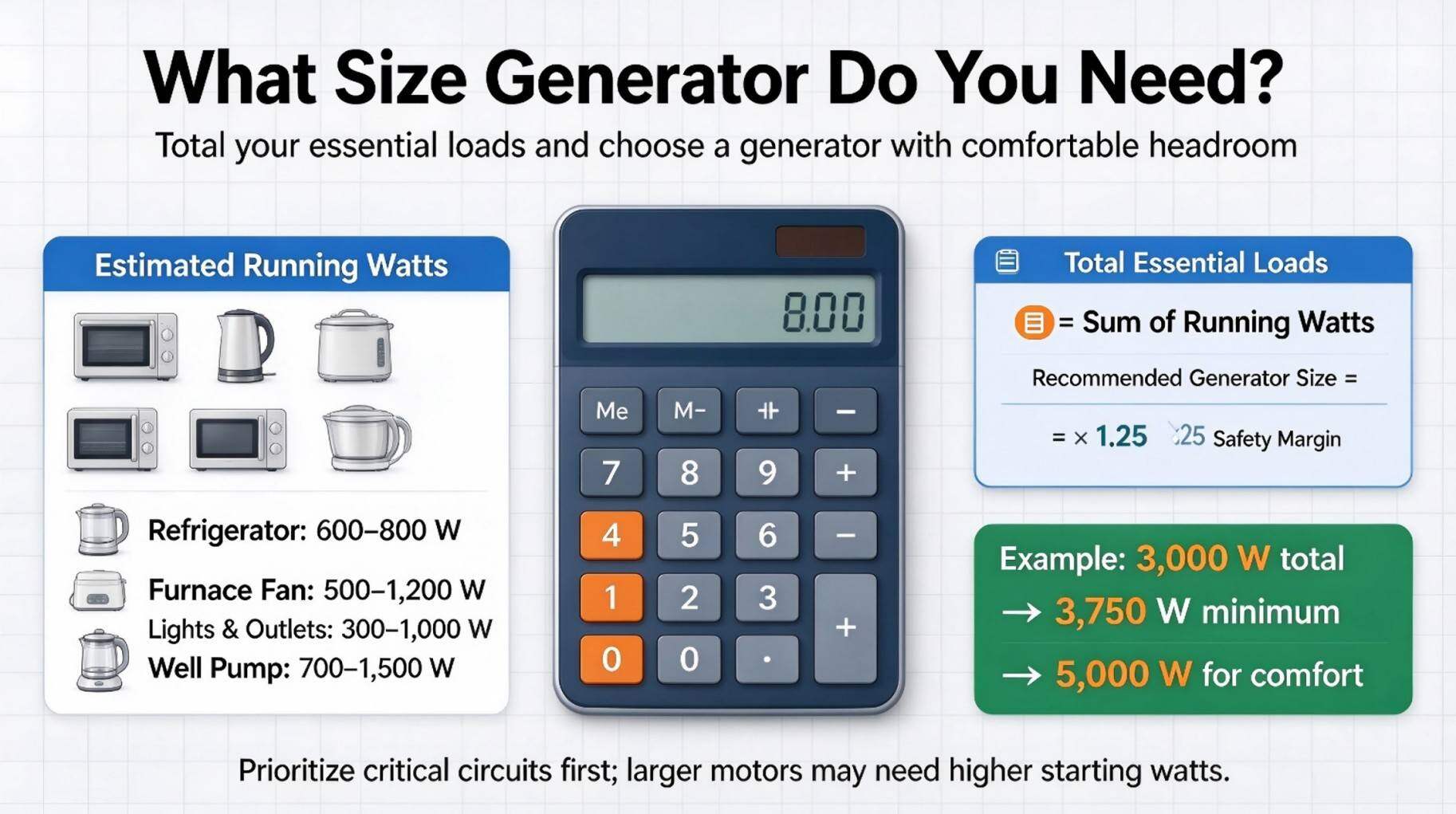
The standard working rule: total the running watts of everything you plan to run together, then swap in the strongest starting surge in place of that appliance's own running watts (the surge number already covers the motor's steady draw), then add roughly 20 percent headroom. Follow that formula and you avoid the two classic failures: undersizing, where the station trips the moment the well pump kicks in, and oversizing, where you overpay at purchase for capacity you never use. A worked example keeps it concrete. Say the essentials total 1,800 running watts, and the biggest motor in the plan, a sump pump, draws 900 of those running watts and surges to 2,400. Swap the pump's 900 running watts for its 2,400 surge (2,400 − 900 = 1,500 added), and peak need becomes about 3,300 watts. Add 20 percent and you land near 4,000 running watts, so a common 5,000- to 5,500-watt portable covers you with room left over. Skip that swap or the 20 percent and a single refrigerator surge can trip the breaker at the worst moment of the storm. A watt-hour is one watt sustained for one hour: a 725Wh station holds 725 watts for one hour, or 60 watts for about ten hours, which is why watt-hours are the number to compare when you shop.
How Many Watts to Run a House: Essentials vs. Whole Home
People ask "how many watt generator to run a house," and the honest answer is: it depends how much of the house you mean. A typical essentials plan, refrigerator, chest freezer, a few LED bulbs, a sump pump, and a furnace blower, lands around 5,000 running watts on a portable unit. Comfort level, adding a window AC or well pump, runs about 7,500 to 10,000 watts. Whole-home coverage including central air normally means a permanently installed unit in the 12,000 to 22,000 watt class, a class that today sits far outside what battery stations offer. Square footage is almost irrelevant; the appliance load is what decides. The table below lists typical ranges for common household loads. Confirm each number on your appliance nameplate, because models differ.
|
Appliance |
Running watts (typical) |
Starting surge (typical) |
|
Refrigerator / freezer |
100–400 |
800–1,200 |
|
Sump pump (1/3–1/2 HP) |
800–1,050 |
1,300–3,000 |
|
Well pump (1/2–1 HP) |
700–2,000 |
2,000–6,000 |
|
Window AC (8,000–12,000 BTU) |
600–1,400 |
1,700–4,000 |
|
Microwave |
800–1,200 |
800–1,200 |
|
Space heater |
1,500 |
1,500 |
|
LED lights, per room |
20–60 |
20–60 |
|
Phone + laptop charging |
50–150 |
50–150 |
|
Wi-Fi router and modem |
20–40 |
20–40 |
If your actual appetite is "keep the router, phone, laptop, a CPAP machine, and maybe a small fridge alive for hours," you do not need a 5,000-watt machine at all. A battery station does that job with zero maintenance. A 725Wh solar generator in the 500–725Wh class delivers 1,000W continuous output (1,500W peak) and pure sine wave AC; a 60W load runs roughly 10 hours on a full charge (725Wh × ~85% usable ÷ 60W). That is the exact niche a battery fills: silent, fume-free, indoor-safe backup for the essentials.
How to Connect a Generator to a House: No Wiring Required
How to connect generator to a house has a different answer when the generator is a battery power station: you do not wire it at all. A portable power station is a self-contained unit with outlets built into the front panel. You connect it the way you connect a power strip, by plugging devices into it directly. That is the entire installation. The U.S. Energy Information Administration frames it cleanly: an energy storage system is discharged "to supply (generate) electricity when needed at desired levels and quality." Nothing to install, no permits, no electrician. The station supplies clean AC power through its own outlets, and your appliances plug straight in. For most people the whole setup takes less than a minute:
- Place the station on a stable, dry surface near the devices you want to power.
- Press the power button.
- Plug each device into the AC outlet (appliances), USB port (phones, tablets, laptops), or DC output (12V accessories) on the front of the station.
- Monitor the display for remaining charge and current draw.
Extension cords work the same way they do with a wall outlet: plug one into the station, run it a few meters to a lamp or a fridge, done. Nothing about this touches the household wiring, which is why a battery station is the one generator you can use in an apartment, a rented house, or any place where you are not allowed to modify the electrical system.
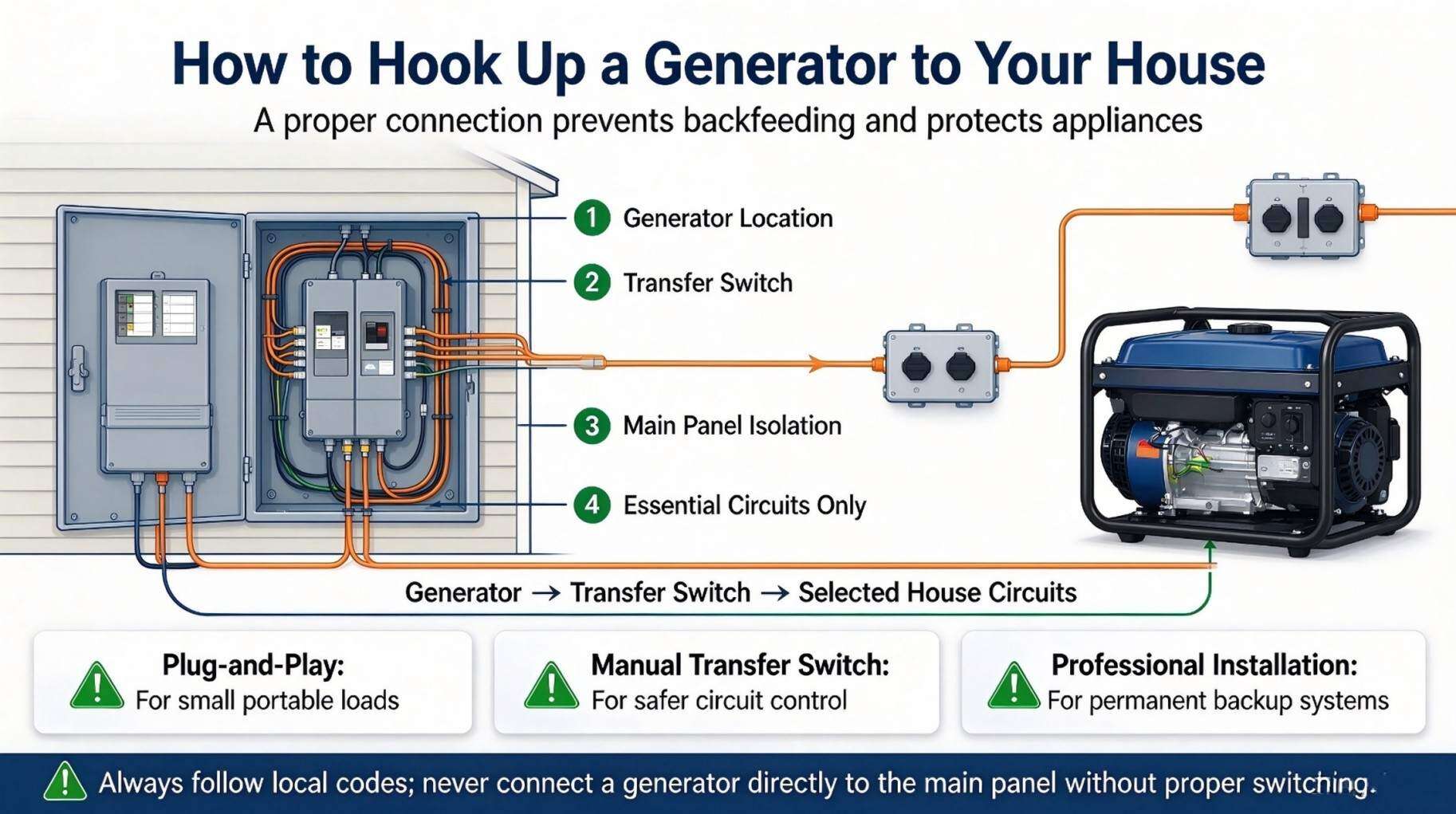
How to Hook Up a Generator to Your House: Step by Step
"how to hook up a generator to your house" is a one-time setup and an every-outage routine, and with a battery station both take minutes. The hookup routine looks like this:
- Place the portable power station in a stable, accessible location near where you need power, on a dry hard surface.
- Confirm all connected devices are turned off.
- Connect your devices to the appropriate ports (AC outlets, USB ports, or DC outputs).
- Press the power button to activate the inverter and begin supplying power.
- Turn devices on one at a time, largest loads first, waiting a few seconds between each.
- Monitor the battery level on the display. When utility power is restored, turn devices off, disconnect them, and recharge the station from the wall or solar.
The exact connections differ between AC, USB, and DC ports, but the routine is the same every time: press the button, plug in, done. Whatever phrasing typed you in, "how to hook up generator to a house," "how to hook up generator to house," or "how to hook up generator to the house," the answer is the same: one button, built-in outlets, no wiring. And once you know how to hook up generator to your house this way, the routine never changes whether you are at home, at a campsite, or on the road.
How to Wire a Generator to Your House: You Don't
"How to wire a generator to your house" and "how to wire generator to house" get a simpler answer from a battery station: you do not. The wiring lives inside the unit, done at the factory. The battery, the charge controller, the inverter, the fuses, and the surge protection are all pre-wired and certified. Your side of the connection is plugging an appliance into a socket, exactly as you would with a wall outlet. That is the whole point of the category. A portable power station needs no installation hardware and no electrician. It is safe to use in any room precisely because there is no connection to your home's wiring to get wrong. One rule still deserves emphasis, because people search for it from bad advice online: never use a double-male "suicide" cord to push power from the station back into a wall outlet. That practice can energize the utility line and endanger a line worker, and it is illegal in every sensible jurisdiction. Use the station's own outlets, and you are safe. The difference is entirely in your hands.
Portable Power Stations: Silent, Clean Backup for What Matters Most
This is where the buying decision actually happens. A portable power station, charged by solar panels, wall power, or a car outlet, represents a completely different approach to backup power. It makes almost no noise, requires no special storage, and runs safely indoors, which makes it the practical choice for apartments, offices, CPAP users, tailgates, and the growing group of homeowners who simply want the router, phones, and a small fridge alive through a few hours of grid failure. The phrase "solar generator" points at a wider idea than the box itself. As the U.S. Department of Energy explains for solar-plus-storage systems, pairing panels with a battery means the electricity you generate during the day can be saved for the evening, for an outage, or for peak-price hours. Applied to a portable station, the same principle gives you a power station that refills itself: panels gather sunlight and the built-in charge controller routes it into the battery, so the station is ready again without you hunting for a wall socket. That is why the solar generator category pairs a station with a foldable panel by default, and why "solar power station" beats "backup battery" as the honest name: the panel is part of the product, not an accessory. The math decides the boundary. If your outage plan fits inside roughly 1,000 continuous watts for hours, a battery station sized 500–725Wh covers a meaningful night: a 60W refrigerator for about 10 hours, laptops recharged several times over, lights for days. If your plan includes central air, an electric water heater, or multi-day whole-home operation, you need larger capacity solutions that go beyond what portable power stations can provide in the mid-2020s consumer market. Many households sensibly use portable power stations for daily backup, travel, and the 90 percent of outages that are short and small, while relying on whole-home battery systems or grid connection for extended outages. The station's role in the house is worth stating plainly. It is not a replacement for your electrical panel; it is a self-contained island of power you bring to the devices you care about. That division of labor is exactly why storage works for homes: as the Department of Energy's storage basics puts it, storage systems capture electricity and "release it for use when it is needed." Your kitchen outlets do the same thing for your router and your coffee maker on an ordinary day, and on a bad day the station quietly takes over that job for a few essential devices. SWAREY builds exactly this category. The S1000 packs 725Wh and 1,000W of pure sine wave AC (1,500W peak) into a compact portable unit, and the smaller 555Wh S550 (550W, 1,100W peak) covers CPAPs and laptops on the go. Both charge from foldable solar panels, wall outlets, or a car's 12V port, carry CE certification and a two-year warranty, and ship across the EU in 3–7 business days. If the essentials-only scenario above matches your outages, this is the category to browse.
FAQ: Straight Answers to the Queries That Brought You Here
How does a portable power station work?
A portable power station stores electrical energy in a lithium battery. You charge it from solar panels, a wall outlet, a car charger, or any available power source. When you need power, the built-in inverter converts the stored DC battery power into clean AC power for your appliances. It operates silently, produces zero emissions, and can be used indoors.
How many watt generator to run a house?
Essentials (fridge, freezer, lights, sump pump, furnace blower) need roughly 5,000 running watts on a portable unit. Adding a window AC or well pump pushes you to 7,500–10,000. Whole-home with central air normally means a permanently installed unit around 12,000–22,000 watts, a class well beyond today's battery stations. A 725Wh power station covers selected essentials for hours, not a whole house.
How to use a portable power station?
Press the power button to turn it on. Plug your devices into the appropriate ports (AC outlets for appliances, USB ports for phones and laptops). Monitor the battery level on the display. When it runs low, recharge it from solar panels, a wall outlet, or a car charger.
How to hook up a generator to a house?
With a battery power station, hookup means pressing the power button and plugging your devices into its built-in outlets. Nothing is wired into your home, so there are no permits and no electrician. Extension cords work exactly as they do with a wall outlet for devices a few meters away.
Can you hook up generator to the house yourself?
Yes, when the generator is a portable power station: place it, press the button, plug in. There is nothing to install, so no permit and no electrician. One universal rule still applies: never use a double-male cord to push power from any generator back into a wall outlet. Done that way, the outlet and the utility line can be energized, and a line worker can be killed. Use the station's own outlets and you stay on the safe side of that rule.
How to hook up house generator for long outages?
Add solar panels and keep the station charged daily. A 725Wh station paired with a 100W solar panel can support the essentials for days as long as sunlight arrives regularly, and a second station doubles your buffer. Recharging from a car's 12V outlet is another way to extend runtime on the move.
How to wire generator to house: what gauge?
With a battery power station you skip the question entirely, because nothing is wired into your home. The internal wiring is done and certified at the factory; your only connection is the power cord of the appliance you plug in. If you do later have a licensed electrician install a fixed input for any backup system, they will size the wire from the circuit rating, run length, and local code — never improvise that part.
The Decision in One Paragraph
Work backward from your actual outage habits. List what must run, and that total decides your battery size. If your list is phone, laptop, router, CPAP, and a small fridge, a portable power station handles it more quietly, more safely, and with zero maintenance. Pick the station that matches those numbers, charge it from the wall or solar panels, and press the button when the lights go out. The generator that works on paper is the one you press, plug, and forget until you need it again, and that is the only test that counts.
*Data as of September 29, 2026. External sources: U.S. Energy Information Administration (EIA) (“Energy Storage for Electricity Generation”), U.S. Department of Energy (DOE) (Grid-Connected Solar: Solar and Energy Storage Basics; Solar + Storage: A Beginner’s Guide). Electrical and capacity calculations follow General Electric standards; code provisions are subject to the U.S. National Electrical Code (NEC) and local regulations; capacity, power, certification, warranty, and shipping information related to SWAREY products are taken from the official product pages and homepage on swareyclub.com.
Subscribe To Our Newsletter
You Can Get The News Of Our Products
SIGN UP
Making every connection simpler, and every charge more valuable.
Payment Methods