Wattage, Amps, Volts, and Voltage Drop: The Home Electricity Math You Actually Use

If you are asking how many solar panels do I need, start with your daily electricity use, not your roof size or a generic national average. A useful first estimate divides daily energy demand by local peak-sun hours and a system derating factor. The result gives the array wattage; dividing that wattage by the rating of one panel gives the panel count.
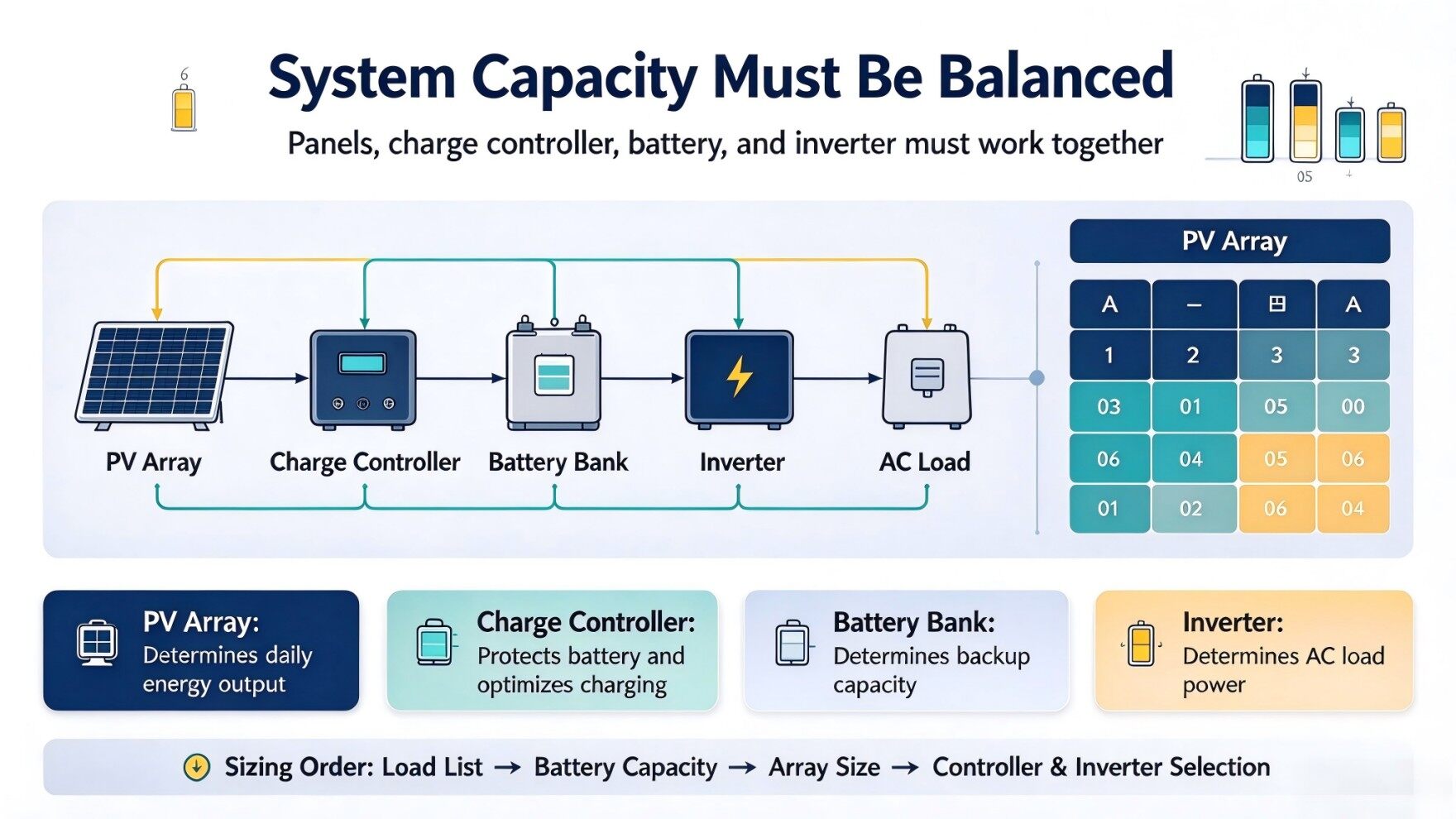
The same load audit also tells you how large the battery bank should be and whether the inverter can run your appliances. Those three numbers answer different questions. Solar-panel watts describe collection capacity, battery watt-hours describe stored energy, and inverter watts describe how much power can be delivered at one moment.
A small portable setup for phones, lights, a laptop, and a compact cooler is not a miniature version of an 80kWh-per-day home. It is a different system with a different job. This guide keeps those scales separate, shows the math, and explains where SWAREY portable power stations fit.
Core terms before you size anything
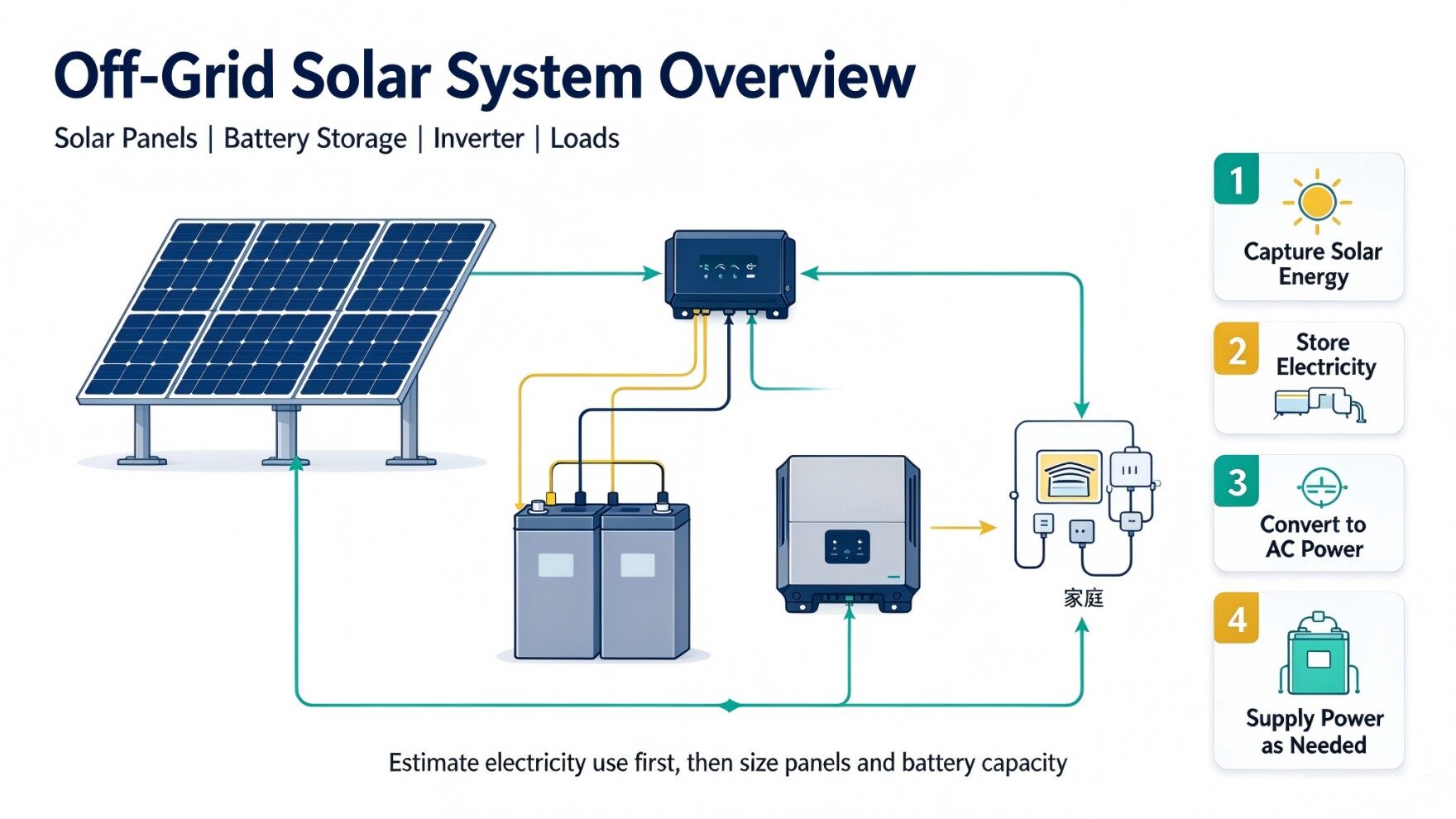
A solar panel is a group of photovoltaic cells wired and sealed into a module that produces direct-current electricity when light reaches the cells.
A battery bank is one or more batteries arranged to store energy for use when the solar array is producing less power than the load requires.
An off-grid solar system supplies selected loads without relying on a utility connection, so its array, storage, conversion equipment, and protection must cover the chosen level of autonomy.
An inverter converts direct-current electricity from a battery into alternating-current electricity for compatible household appliances. A pure sine wave inverter produces an AC waveform suited to sensitive electronics, subject to the device maker's requirements.
An MPPT charge controller adjusts panel operating voltage and current to seek the array's maximum power point as sunlight and temperature change.
A battery management system (BMS) monitors battery conditions and applies protections such as over-current, over-temperature, short-circuit, over-charge, and over-discharge control.
LiFePO4 is a lithium iron phosphate battery chemistry valued for cycle life and thermal stability. Chemistry claims must be checked model by model; among the products discussed here, SWAREY's current S200 page explicitly identifies LiFePO4, while the checked S500 and S1000 pages do not state their cell chemistry.
These definitions prevent a common sizing error: buying enough stored energy but too little output power. A 1,000Wh battery may hold enough energy for a task, yet a 500W inverter cannot run a 900W appliance.
How is solar energy made?
Solar electricity begins in a photovoltaic cell. According to the U.S. Department of Energy, a PV cell contains semiconductor material that absorbs sunlight and converts it to electricity through the photovoltaic effect. The cell produces direct current. Cells are connected into a module, modules can be connected into an array, and an inverter converts the DC output into AC when AC loads need it.
That conversion chain matters because every stage has limits. Panel output changes with irradiance, temperature, shading, dirt, wiring, orientation, and the input limit of the receiving equipment. A panel's nameplate rating is a laboratory reference, not a promise that it will deliver that wattage every hour outdoors.
Storage fills the timing gap. The Department of Energy notes that solar production and electricity demand do not always occur at the same time. A battery bank stores part of the daytime production and releases it later, but charging and conversion losses mean that one kilowatt-hour collected at the panel does not become one full kilowatt-hour at the appliance.
Step 1: build a load audit before buying panels
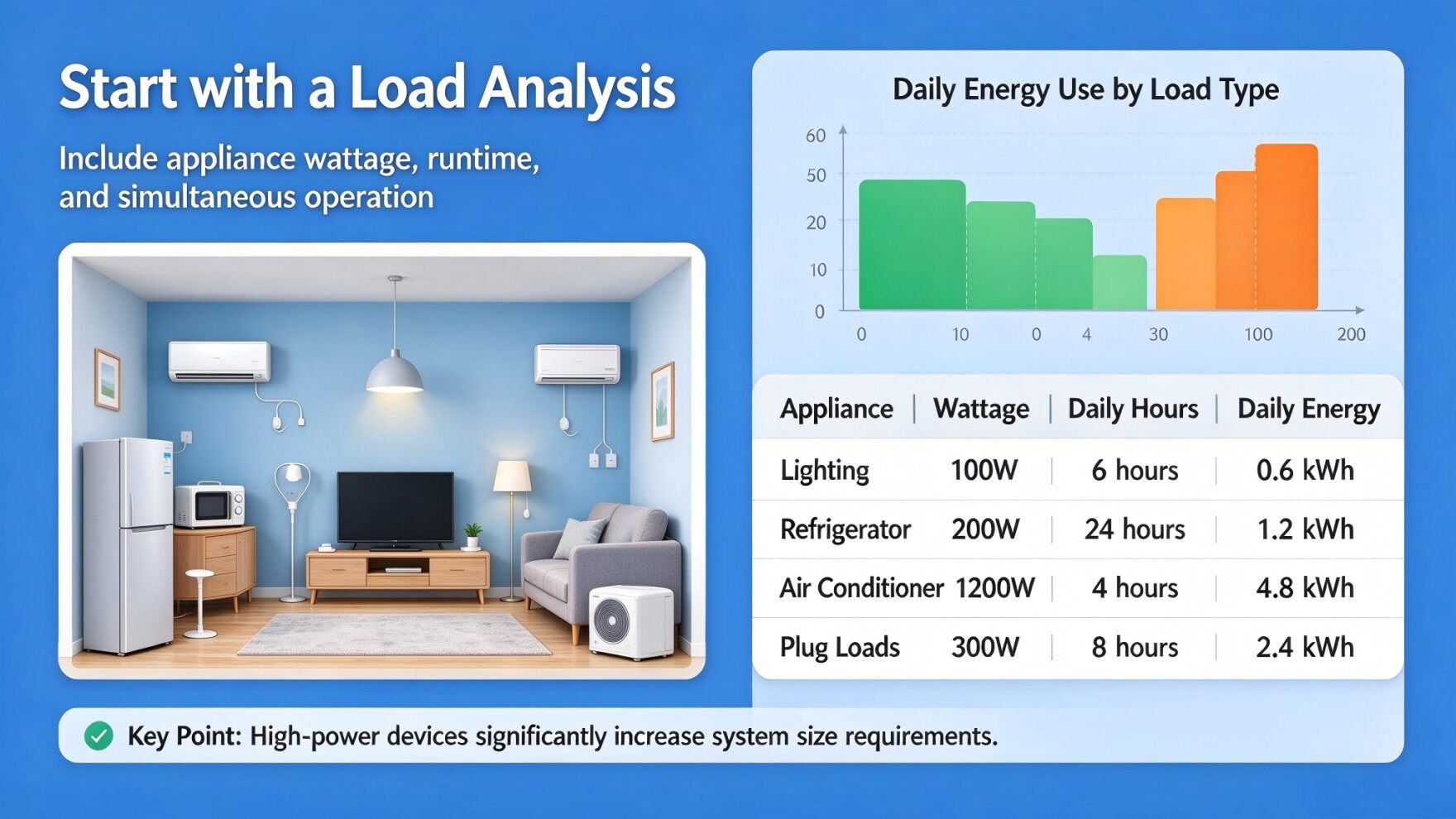
A load audit is a list of each device's running power, daily operating time, and startup requirement. Use the label on the actual appliance or a plug-in meter where practical. Online averages are useful for rough planning, but refrigerators, pumps, medical devices, and power tools vary widely.
Use this formula for each device:
Daily energy (Wh) = Running power (W) × Operating time (h/day)
Then add every row:
Total daily energy (Wh/day) = Σ device daily energy
The sample below is an illustration, not a substitute for measured values.
|
Example load |
Assumed running power |
Daily use |
Daily energy |
What to verify |
|
Efficient refrigerator |
150W |
8 equivalent hours |
1,200Wh |
Compressor startup power and measured duty cycle |
|
Laptop |
60W |
6 hours |
360Wh |
Charger label and real charging pattern |
|
Router |
12W |
24 hours |
288Wh |
Adapter rating |
|
Five LED lamps |
50W total |
5 hours |
250Wh |
Number of lamps and actual wattage |
|
Water pump |
750W |
0.5 hour |
375Wh |
Startup surge and pump controls |
|
Illustrative total |
|
|
2,473Wh/day |
Add seasonal and future loads separately |
Do not hide intermittent loads inside a vague allowance. If an induction cooker runs at 1,500W for 30 minutes, it adds 1,500W × 0.5h = 750Wh/day. It also requires an inverter that can deliver 1,500W while the cooker is on, even though its daily energy use is only 750Wh.
Step 2: how many solar panels do I need?
A first-pass solar-array formula is:
Array size (W) = Daily energy (Wh) ÷ [Peak-sun hours (h) × System derating factor]
Peak-sun hours are not the number of daylight hours. They express the day's solar energy as equivalent hours at 1,000W/m². Use a reputable location-based solar-production tool, then check the weakest relevant season rather than sizing from the best summer month.
The derating factor accounts for real losses. For an early estimate, this guide uses 0.80, but the final value should reflect the actual module temperature, wiring, charge controller, inverter, battery, shading, and layout.
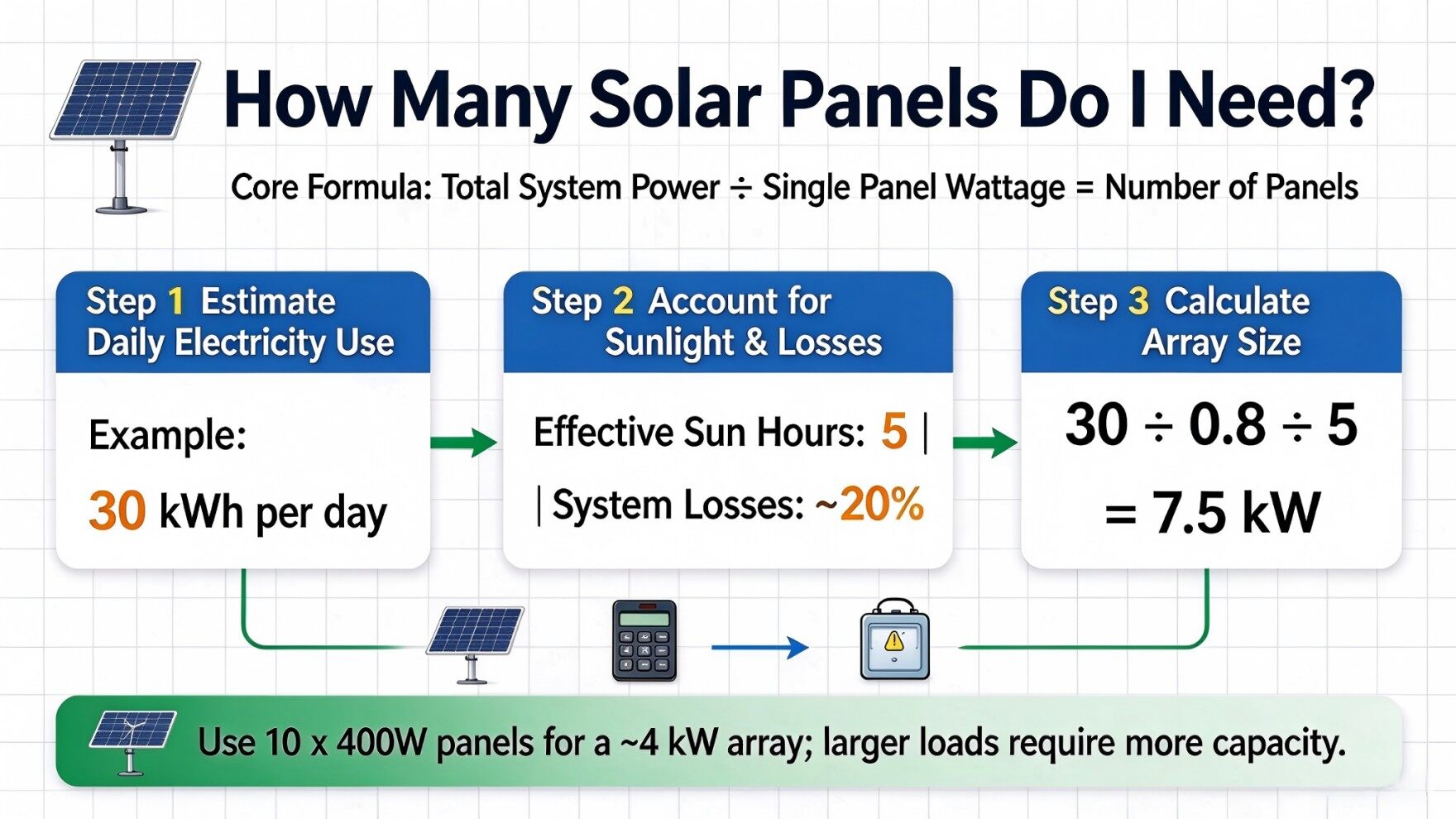
For the 2,473Wh/day sample with 4 peak-sun hours:
2,473Wh ÷ (4h × 0.80) = 772.8W
Round up to an array size that fits available equipment and design constraints. With 200W modules, the arithmetic gives:
772.8W ÷ 200W per panel = 3.864 panels
Round up to four 200W panels for an 800W nameplate array. That is still a planning estimate. It does not confirm electrical compatibility, winter performance, mounting suitability, or local code compliance.
How many solar panels to power a house: worked examples
The table uses 400W modules, five peak-sun hours, and a 0.80 derating factor to make the comparison easy to audit. The 400W module is a neutral calculation example, not a SWAREY product specification.
|
Daily demand |
Array calculation |
Estimated array |
400W module calculation |
Rounded panel count |
|
10kWh/day |
10,000 ÷ (5 × 0.80) |
2,500W |
2,500 ÷ 400 |
7 |
|
20kWh/day |
20,000 ÷ (5 × 0.80) |
5,000W |
5,000 ÷ 400 |
13 |
|
30kWh/day |
30,000 ÷ (5 × 0.80) |
7,500W |
7,500 ÷ 400 |
19 |
|
80kWh/day |
80,000 ÷ (5 × 0.80) |
20,000W |
20,000 ÷ 400 |
50 |
This is why how many solar panels to power house has no honest one-number answer. Two homes with the same floor area can have different heating, cooling, water pumping, cooking, vehicle charging, and occupancy patterns. Location changes the answer again.
For a grid-independent home, the critical design month may produce far less solar energy than the annual average. A system that balances neatly on paper in July can fall short after several cloudy winter days. Final design should use local monthly production data and a qualified professional's electrical and structural review.
Step 3: how many batteries needed for daily 80 kWh?
An 80kWh daily load is an entire-home-scale project. Battery count depends on each battery's nominal capacity, permitted depth of discharge, conversion efficiency, and the number of autonomy days required.
Use this formula:
Nominal battery capacity (kWh) = Daily load (kWh) × Autonomy days ÷ [Allowed discharge fraction × Inverter efficiency]
For one day of autonomy, 90% allowed discharge, and 90% inverter efficiency:
80kWh × 1 day ÷ (0.90 × 0.90) = 98.77kWh nominal
Always round up and then verify the manufacturer's usable-energy definition. In this example, the bank needs at least 98.77kWh of nominal storage before adding a reserve for battery aging, low-temperature behavior, or future loads.
|
Nominal capacity per battery module |
Estimated usable AC energy per module at 90% discharge and 90% efficiency |
Calculation for 80kWh |
Rounded module count |
|
5kWh |
4.05kWh |
80 ÷ 4.05 |
20 |
|
10kWh |
8.10kWh |
80 ÷ 8.10 |
10 |
|
15kWh |
12.15kWh |
80 ÷ 12.15 |
7 |
For two autonomy days, double the energy term:
80kWh × 2 ÷ (0.90 × 0.90) = 197.53kWh nominal
This calculation only sizes energy. The battery system must also meet charge and discharge current, inverter voltage, thermal, enclosure, protection, communication, and code requirements. Large banks require engineered integration; the arithmetic alone is not a construction plan.
The scale comparison is worth making explicit. A SWAREY S1000 stores 725Wh, or 0.725kWh. Ignoring all losses, 80kWh ÷ 0.725kWh = 110.34, so even a simple energy comparison rounds up to 111 units. That is not a sensible architecture. The S1000 is a portable power station for selected devices, not a substitute for a professionally designed 80kWh-per-day home battery system.
Step 4: choose the inverter from simultaneous and startup loads
Continuous load is the power that connected equipment requires while running; startup load is the brief higher demand that some motors and compressors draw when they start.
Add the equipment that may operate at the same time. If a 150W refrigerator, 750W pump, 60W laptop, and 50W of lighting overlap, the running total is:
150W + 750W + 60W + 50W = 1,010W
That total already exceeds a 1,000W inverter before allowing for startup demand. A final design must use measured or manufacturer-provided startup values, not guesses. It must also respect the inverter's voltage, waveform, thermal, and protective-device requirements.
Capacity cannot fix an undersized inverter. Likewise, a large inverter cannot create energy that is not in the battery. Check daily Wh, continuous W, and peak W as three separate gates.
How to go off grid with solar: a practical sequence
Going off grid is a design process, not a single product purchase. Work through these steps in order:
- Define the loads you will actually support.Separate essential loads from optional ones. Moving resistance heating, water heating, or heavy workshop equipment to a different energy plan can change the system size dramatically.
- Measure a representative period.Gather daily energy use across hot, cold, busy, and quiet periods. Include standby loads and equipment that cycles.
- Set the autonomy target.Decide how many low-solar days the battery bank must cover and what load reductions you will accept during extended poor weather.
- Model local solar production.Use location, tilt, orientation, shading, and monthly weather. A location-based production estimate is suitable for early planning, but the final design must account for the actual site.
- Size the array and battery bank.Apply the formulas above, then test winter and low-production scenarios.
- Select the inverter and charge controller.Match system voltage, continuous load, startup demand, array voltage/current, and charging limits. MPPT does not make incompatible equipment compatible.
- Design protection and installation.Disconnects, over-current protection, grounding, cable sizing, enclosure, ventilation, mounting, and permits require project-specific review.
- Plan commissioning and maintenance.Verify polarity and settings before energizing, record baseline readings, inspect connections, keep panels clear, and review battery alerts.
For a small portable setup, the experience is much simpler because the battery, BMS, outlets, and inverter or DC outputs are packaged together. With a compatible SWAREY configuration, press the power button, then connect a phone, tablet, laptop, light, or appliance that stays within the unit's output limits. Solar recharging still requires a panel whose voltage, current, connector, polarity, and power are compatible with the station's input.
Where SWAREY S200, S500, and S1000 fit
Portable power stations work best when the load list is short and specific. Choose by the ports you need, stored energy, continuous output, startup output, and accepted solar input. Do not select by capacity alone.
|
Model |
Verified capacity |
Verified output facts |
Solar-input fact |
Sensible role |
|
SWAREY S200 |
192Wh |
180W DC; two USB-C ports rated up to 140W; no AC outlet stated |
Up to 100W on the checked page |
Phones, tablets, USB-C laptops, cameras, and DC loads within limits |
|
SWAREY S500 |
518Wh |
500W pure sine wave AC; 1,000W peak |
Up to 126W |
Router, lighting, laptop, compatible CPAP, or compact cooling loads after startup check |
|
SWAREY S1000 |
725Wh |
Two AC outlets; 1,000W rated, 1,500W peak |
Up to 126W |
A larger portable load set, still well below whole-home scale |
The S200 is the most direct fit for USB-C-centered travel or work. Its current product page identifies a 192Wh LiFePO4 battery and 3,500-cycle claim, but it does not list an AC outlet. Use it for compatible USB and DC devices rather than assuming it can run a household AC appliance. Press the power button and connect the phone, tablet, or compatible laptop to the correct port.
The S500 is a better bridge to small AC loads. Its 518Wh battery and 500W pure sine wave AC output can serve a router, lights, a laptop, or another device whose running and startup demand fit the limits. A simple idealized runtime for a 50W load is 518Wh ÷ 50W = 10.36 hours; real runtime will be lower because conversion and standby losses consume energy.
The S1000 raises the continuous AC ceiling to 1,000W and stores 725Wh. For a 100W combined load, 725Wh ÷ 100W = 7.25 hours is the loss-free ceiling, not a guaranteed runtime. Use the actual load, temperature, battery state, and conversion path to set expectations.
Before pairing any station with a panel, check input voltage, current, maximum accepted solar power, connector, and polarity. A 200W panel connected to a station that accepts only 126W cannot force the station to take 200W. Panel angle, cloud, heat, and shade may reduce production further.
How to make a solar panel: understand the factory process first
A commercial solar panel is made by electrically connecting photovoltaic cells, laminating them between protective layers, sealing the assembly against the environment, adding a frame and junction box, and testing electrical output and insulation. Each layer has a job: the front surface admits light, encapsulant protects the cells, the back layer provides environmental and electrical protection, and the junction box carries current out of the module.
That overview answers the manufacturing question without pretending that a home-built panel is equivalent to a tested module. Hand-soldered cells are fragile, moisture can damage an imperfect laminate, and poor insulation or connections can create electrical and fire hazards. For equipment that will charge a battery bank or connect to a home electrical system, use a properly rated finished module and have the system reviewed under local rules.
If the goal is education, a low-voltage classroom cell kit can demonstrate the photovoltaic effect. If the goal is dependable off-grid power, spend the effort on load measurement, compatible components, safe mounting, and professional electrical design instead of attempting to fabricate the module itself.
A final pre-purchase check
Run these checks before ordering equipment:
- Confirm daily energy in Wh or kWh from real appliance data.
- Confirm the highest simultaneous running load in W.
- Confirm startup demand for motors, compressors, and pumps.
- Use local monthly solar production rather than an annual average alone.
- Set battery autonomy and allowed discharge assumptions in writing.
- Check panel voltage, current, connector, polarity, and array limits.
- Check the power station or controller's maximum solar input.
- Include protection, cable, mounting, weather, permit, and installation requirements.
- Keep whole-home design separate from portable-device backup.
For portable power, compare the SWAREY solar panel range, then match it to the input specification of the station you choose. The SWAREY S200, SWAREY S500, and SWAREY S1000 cover different load ranges. List your devices first, then choose the smallest model that meets energy, continuous-output, startup, and port requirements with a sensible margin.
Frequently Asked Questions
How many solar panels do I need for an off-grid home?
Divide daily Wh by peak-sun hours and a derating factor, then divide the resulting array watts by one panel's wattage and round up. For 10kWh/day, five peak-sun hours, a 0.80 derating factor, and 400W modules: 10,000 ÷ (5 × 0.80) ÷ 400 = 6.25, so the first estimate is seven panels. Recheck it against local monthly conditions.
Can a portable power station run an entire house?
A portable station can run selected loads that fit its stored-energy and output limits. It should not be treated as an entire-home system. Whole-home operation may require tens of kilowatt-hours per day, a large battery bank, high-power conversion equipment, protection, permitting, and professional installation.
How large should a battery bank be for one day of autonomy?
Use daily load × autonomy days ÷ (allowed discharge fraction × inverter efficiency). For 20kWh/day, one day, 90% allowed discharge, and 90% efficiency, the estimate is 20 ÷ (0.90 × 0.90) = 24.69kWh nominal before aging and temperature reserves.
What is the difference between W and Wh?
Watts measure power at a moment; watt-hours measure energy over time. A 100W device used for five hours consumes 100W × 5h = 500Wh. A battery and inverter must satisfy both the Wh requirement and the W requirement.
Why does a solar panel rarely deliver its nameplate wattage all day?
Nameplate power is measured under specified test conditions. Outdoor production changes with sunlight intensity, angle, cell temperature, clouds, shade, dirt, wiring losses, and the receiving device's input limit. Use a location-based model and measured field data for final planning.
Does a larger panel always recharge a portable power station faster?
No. The station's accepted voltage, current, and maximum solar input set the ceiling. A 200W panel connected to a station with a 126W input limit may still be useful in weaker light, but the station will not accept more than its designed limit. Connector and polarity must also match.
Sources
- S. Department of Energy, [Solar Photovoltaic Cell Basics](https://www.energy.gov/cmei/systems/solar-photovoltaic-cell-basics)
- S. Department of Energy, [Solar PV System Design Basics](https://www.energy.gov/cmei/systems/solar-photovoltaic-system-design-basics)
- S. Department of Energy, [Solar Energy and Storage Basics](https://www.energy.gov/cmei/systems/solar-integration-solar-energy-and-storage-basics)
Subscribe To Our Newsletter
You Can Get The News Of Our Products
SIGN UP
Making every connection simpler, and every charge more valuable.
Payment Methods