Portable Power Station Size Guide: How to Choose the Right Capacity

Plug in a phone and it charges. Flip a switch and a room lights up. The effect feels effortless, which is why most of us never stop to ask where the current comes from. When you do stop, the question gets interesting fast. The honest answer to "how is electricity made" is that nobody manufactures it out of nothing. Every electron that powers your coffee maker started as a different form of energy, usually sunlight, wind, falling water, or heat, and went through a conversion to become current. This article walks through that conversion, the people who figured it out, and the surprising fact that you can run the same physics in your kitchen.
How Is Electricity Made? The Short Answer
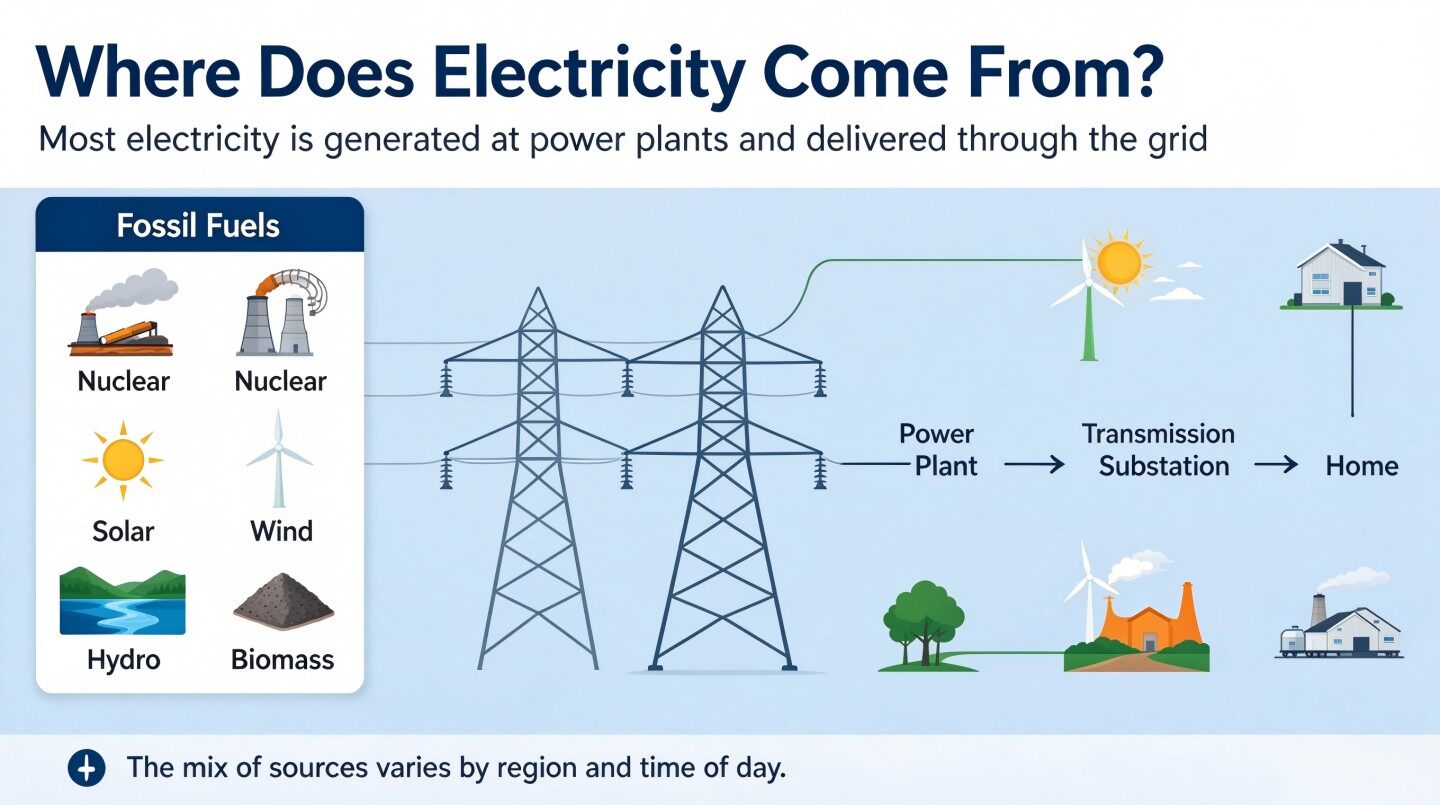
Current means electrons on the move. These tiny negatively charged particles live inside atoms, and when something pushes them along a conductor such as a copper wire, you get electricity flowing through it. Nothing pushes them by itself. As Stanford's Understand Energy project notes, electricity is a secondary energy resource: we have to build it from primary energy resources, because a usable charge is not sitting around waiting to be collected.
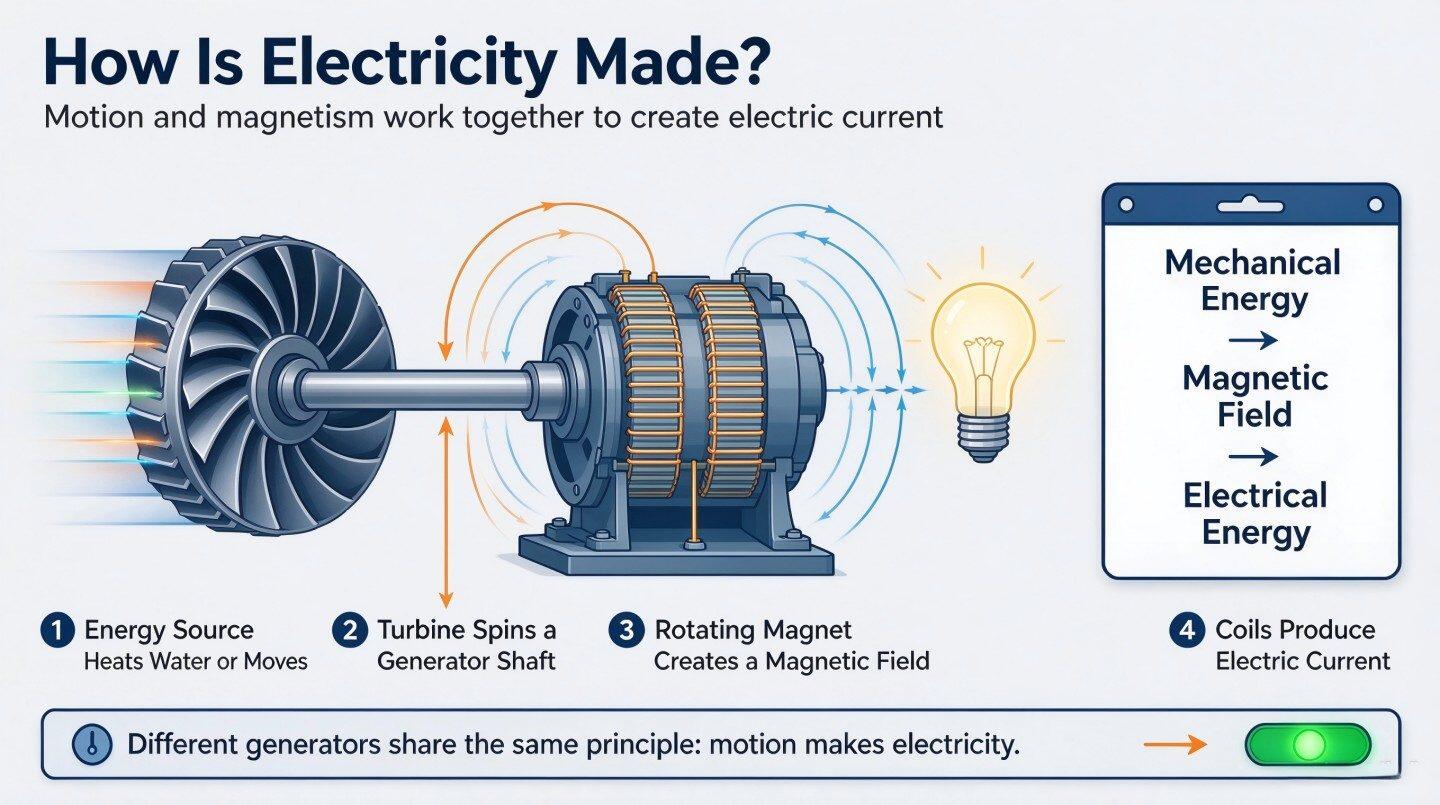
Two physical tricks produce almost all of it. The first is electromagnetic induction, discovered by Michael Faraday in 1831. His classic experiment: slide a magnet through a loop of copper wire and a current appears in the wire; pull it back out and the current flows the other way. The U.S. Energy Information Administration describes an electric generator as a device that converts a form of energy into electricity, and most large-scale generation still rests on Faraday's basic setup: a rotor turning inside a stationary set of wire coils. The second trick is the photovoltaic effect. Some materials, silicon being the famous one, release electrons when photons of sunlight strike them. No moving parts, no spinning shaft.
"Solar photovoltaic cells convert sunlight directly into electricity," notes the EIA, and those cells can be as small as the one in a wristwatch or wired into panels that power whole neighborhoods. For anyone who wants to understand how to create electricity on their own terms, the photovoltaic route matters most, because it is the one method that works at kitchen-counter scale.
Keep both mechanisms in mind and every power station you have ever seen becomes easier to read. Whether the input is wind, falling water, or concentrated heat, the station exists to get something spinning near a coil, or to catch photons on a semiconductor. Everything else is engineering.
Who Made Electricity? Five Names Worth Knowing
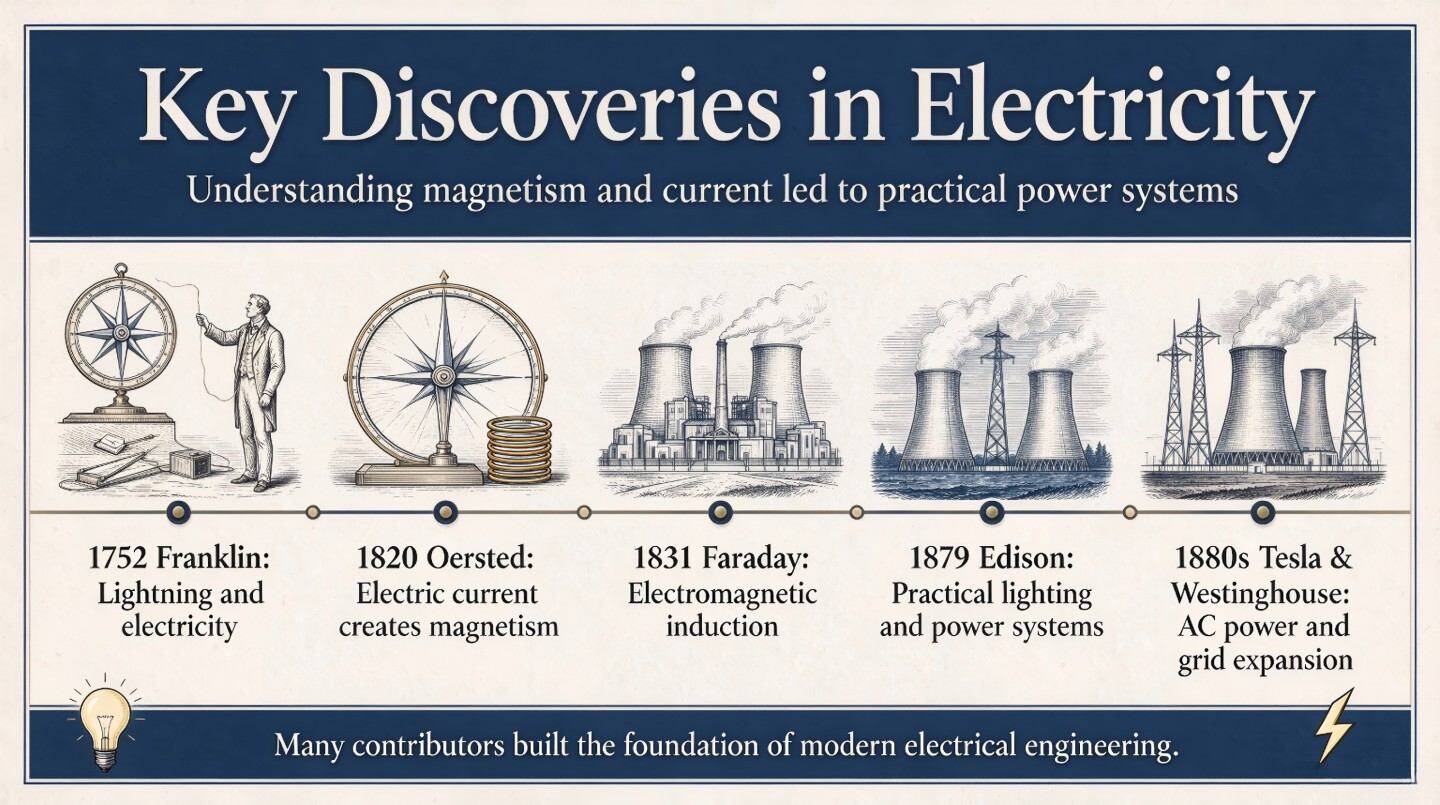
The honest answer to "who made electricity" is that no single person did. Static charges were noticed in ancient Greece, where rubbing amber against fur produced sparks; the modern understanding of the subject took shape over roughly a century and a half of experiments. Five names carry most of the story.
Alessandro Volta built the first working battery in 1800. His voltaic pile stacked zinc and copper discs separated by cloth soaked in salt water, and it produced a steady current that researchers could study on demand. That device gave science its first reliable, portable source of electrons.
Benjamin Franklin tied lightning to electricity in 1752, flying a kite with a metal key during a thunderstorm. The EIA's Energy Kids timeline credits him with proving that the static crackle you get from a charged surface and a lightning bolt are the same thing. He also gave us the language of positive and negative charge.
Michael Faraday, in 1831, proved that electricity can be induced by changes in an electromagnetic field. His induction ring became the blueprint for every generator and transformer that followed. If one person deserves the title "father of generation," it is Faraday, though he never sought the honor.
Thomas Edison turned the science into a service. The EIA's timeline also records that in 1882 he opened the Pearl Street power station in New York City, one of the world's first central electric power plants, and his direct-current system lit thousands of bulbs.
Nikola Tesla answered with alternating current, which traveled farther and cheaper; the "current war" ended with Tesla's AC becoming the backbone of every modern grid, and with it the transformers and long-distance lines we still rely on.
History trivia has a practical payoff here. The battery, the induction principle, and the solar cell are all older than you might think, and all three are exactly what a modern solar generator recombines into one portable box. Understanding that lineage makes the hardware easier to trust.
How Is Electricity Generated Around the World
Across the planet, the same three routes dominate generation. The first is heat-based generation, where thermal plants use steam to spin turbines that rotate generators. The second is direct kinetic capture: wind turns blades, falling water turns runners, and both spin the same kind of coil-and-magnet assembly. The third is solar photovoltaics, which skips the turbine entirely.
Stanford's Understand Energy team estimates the split at roughly 73 percent for heat-based generation, 22 percent for direct kinetic resources, and about 5 percent for solar photovoltaics in world electricity generation. Those numbers shift every year, with solar climbing steadily as panel prices fall.
What matters for a homeowner is not the global mix but where the personal market sits. Utility-scale generation is built around turbines because they handle megawatts efficiently. At the scale of a home, a laptop, or a camping trip, turbines make no sense at all. You do not need a dam to charge a phone. You need a panel, a battery, and an inverter, which is why distributed solar keeps growing so quickly among households.
How Is Electricity Created From Sunlight?
Light does not look like energy, but every beam carries photons, and photons arriving at a solar cell transfer their energy to electrons in the semiconductor material. That kick frees the electrons, and the cell's internal electric field pushes them in one direction, producing direct current. String many cells together and you have a panel with a real voltage on its terminals. This is the cleanest conversion in the whole book of energy physics.
No heat, no noise, no moving parts. The panel silently turns daylight into current the moment it is exposed to the sky, and it keeps doing it for decades. The only catch is timing: the sun sets, clouds pass, and seasons change, so the power comes in waves. That is why generation alone is rarely enough, and why storage is the second half of the equation. A panel without a battery is a tap that only runs in daylight.
How Can You Create Electricity at Home?
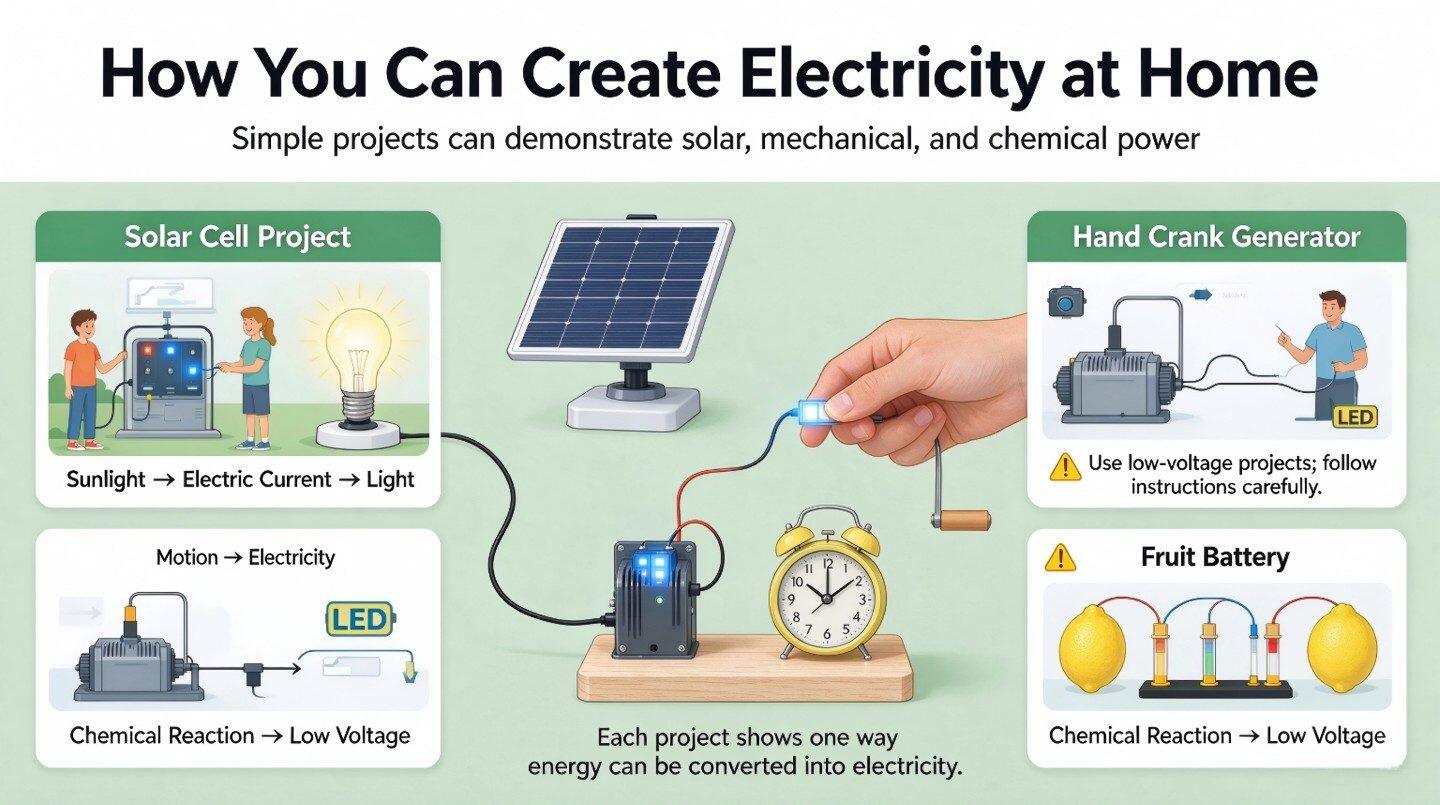
If you want to create electricity at home without rewiring the house, three options deserve attention, and they are not equally practical. A grid-tied rooftop solar system is the heavyweight option. It produces meaningful power every sunny day, feeds your home first, and can pay for itself over years through reduced bills. But it comes with installation costs, permits, and a licensed electrician, and it is tied to the property, so renters and travelers cannot take it with them.
A small wind turbine only pays off with sustained wind speeds most urban addresses simply do not have, and micro-hydro needs a flowing water source near the property. Both are location lottery tickets. Then there is the portable route: a folding solar panel connected to a battery power station. This is the setup that works for everyone, because it needs no permits, no wiring, and no permanent installation. You unfold the panel in sunlight, plug it into the station, and the station stores the day's energy for the evening, the blackout, or the trip. For an apartment dweller, a renter, or a weekend camper, it is the only one of the three that converts sunlight into usable electricity tonight, not next quarter.
How to Create Electricity That Fits in a Backpack
The practical version of "how to create electricity" for most households is a portable power station paired with a solar panel. The panel is a photovoltaic array in miniature. The station is a lithium battery with an inverter built in, which converts the stored direct current into the alternating current that household devices expect.
Press a button, plug in a phone or a laptop, and you are using sunlight that fell an hour ago. Batteries deserve a moment of respect here. They store chemical energy and release it as electricity, which means the station does not invent power; it banks it. A 725Wh station, for example, holds about 725 watt-hours of energy, enough to charge a phone roughly forty times, keep a laptop running for many work sessions, or power a small fridge through an outage. Solar generators in this class, such as the S1000 with its 725Wh battery and 1000W rated output, are built around exactly this loop: catch daylight, store it safely, release it cleanly. A portable power station S550 covers the lighter end of the same spectrum, and pairing either one with a folding solar panel turns any sunlit windowsill into a micro power plant.
The battery chemistry behind this class of station is engineered for safety and longevity, so the unit stays cool, holds thousands of charge cycles, and needs no maintenance. There is nothing to service, nothing to refill, and nothing to dispose of after a season of use. The hardware simply sits there charging by day and discharging by night, for years.
How to Create Electrical Energy You Actually Control
Generating your own current is only half the win. The quieter benefit is control. When the grid dips or a storm rolls through, a household with a charged power station keeps its lights, its router, and its fridge running without waiting for a repair crew.
That independence is what pushes many people from curiosity to purchase. Sizing is straightforward. List what you want to keep alive, add up the running watts, and pick a station that covers the number with headroom. A 300W laptop load plus a 60W router plus a phone leaves plenty of room on a 550W station; adding a fridge pushes you toward the 1000W class. Panels follow a similar logic: a 100W panel restores a depleted 725Wh battery in roughly a day to a day and a half of good sun, so the pair works as a rolling cycle rather than a one-time fill.
One more consideration that usually settles the decision: the same station that backs up the home on a stormy night is the one that keeps the campsite charged in summer. A single device serving emergency power and weekend freedom is a different purchase than a dedicated backup system bolted to a wall.
Frequently Asked Questions
How is electricity made?
Electricity is produced by converting another form of energy, usually kinetic or light energy, into electrical energy. Most generation uses electromagnetic induction, where a magnet moving near a wire coil makes electrons flow; solar panels instead convert sunlight directly into current through the photovoltaic effect.
Who made electricity?
No one invented electricity itself, which exists in nature. Alessandro Volta built the first battery in 1800, Michael Faraday discovered electromagnetic induction in 1831, Thomas Edison opened the first power station in 1882, and Nikola Tesla championed the alternating current that grids still use today.
How is electricity created in a solar generator?
A solar panel converts sunlight into direct current, a battery stores that current as chemical energy, and an inverter converts it to the alternating current that home devices use. That is the entire loop behind a modern portable power station.
How can you create electricity without a roof?
Use a foldable solar panel and a portable power station. The panel produces current in any open sunlight, the station stores it, and everything fits in a boot or a backpack, no permits or wiring required.
How to create electrical energy from activity like pedaling?
Mechanical energy from movement can also spin a small generator or charge a dynamo hub, the same induction principle Faraday described in 1831. It works, but it is labor-intensive, which is why solar remains the practical default for household-scale generation.
The Takeaway: Generation Is Physics, Not Magic
When you ask how is electricity made, the answer turns out to be a chain of conversions. Light, wind, and motion become current, current becomes stored chemical potential in a battery, and stored potential becomes the power in your hands when you need it. Faraday, Volta, and the inventors of the solar cell built that chain one experiment at a time, and you do not need a power plant to take part in it.
A panel and a battery give you a private, quiet slice of the same physics, ready anywhere a little sun falls. SWAREY builds exactly that chain into its CE-certified solar generators, shipped across the EU within 3-7 business days and covered by a 2-year warranty.
Sources
- S. Energy Information Administration, "How electricity is generated": eia.gov/energyexplained/electricity/how-electricity-is-generated.php(accessed October 8, 2026)
- S. Energy Information Administration, Energy Kids, "Electricity timeline": eia.gov/kids/history-of-energy/timelines/electricity.php(accessed October 8, 2026)
- Stanford University, Understand Energy Learning Hub, "Understand Electricity": understand-energy.stanford.edu/news/understand-electricity(accessed October 8, 2026)
This article is published for general information. Product specifications, delivery options, and certifications refer to SWAREY's official listings at swareyclub.com, including EU-wide delivery within 3-7 business days, a 2-year warranty, and EU CE certification, and are accurate as of the date above.
Subscribe To Our Newsletter
You Can Get The News Of Our Products
SIGN UP
Making every connection simpler, and every charge more valuable.
Payment Methods